
 Sharathon · RecapSharathon · Recap
Group photo, decks, tools, the gallery of what people built, and where the next one gets announced. This page is the permanent home for Sharathon resources.
The map takes three taps: how you work with AI today, which job eats your week, and where you sit on that line. You leave with your coordinate and one move for this week.
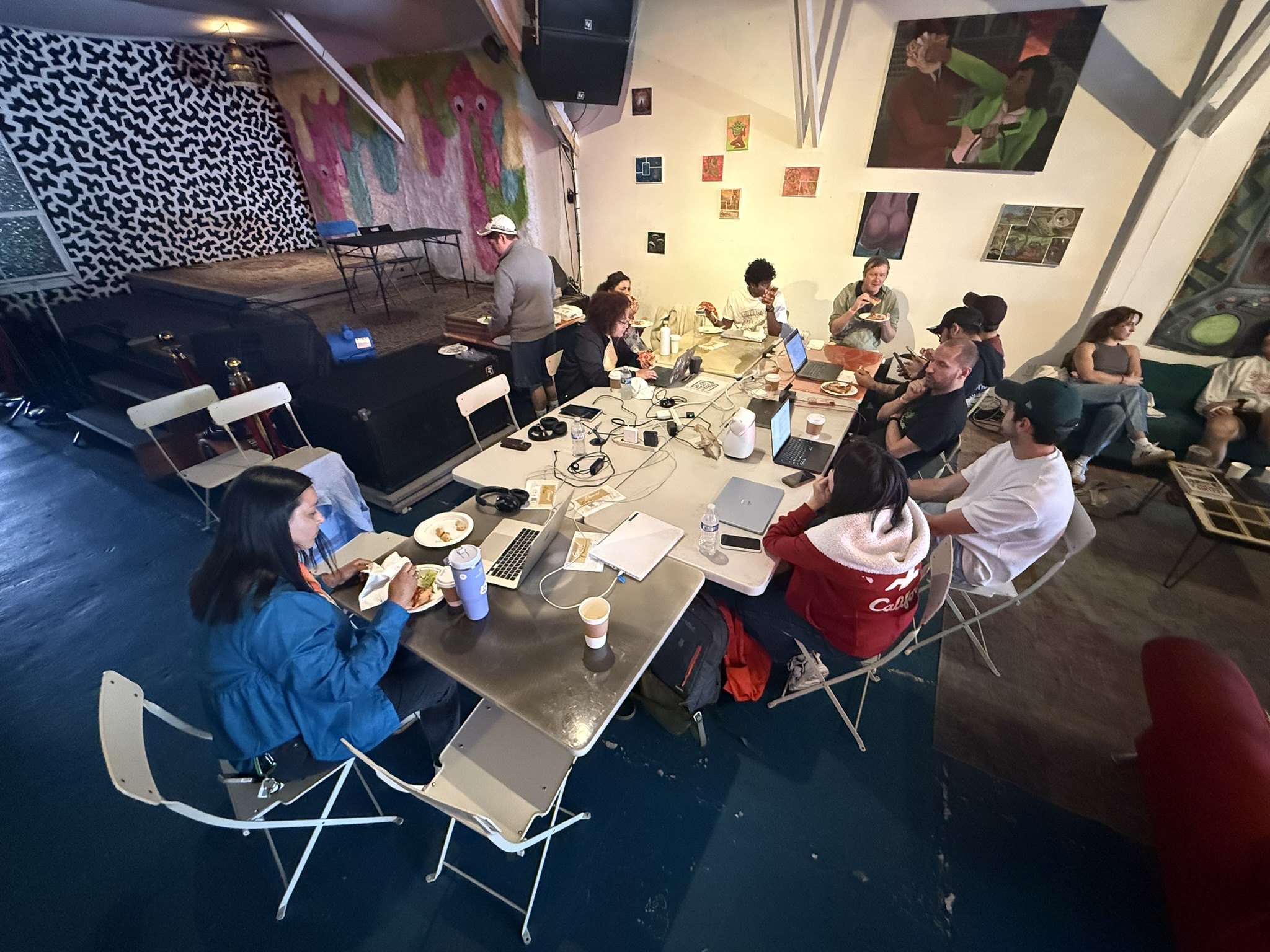
64 people signed up. 15 builders showed up to a coffee shop in Ocean Beach on a Saturday morning, pizza on the house from Blue Barn Creative, and built things side by side. No panels. No pitches. Just people sharing what they're working on.
August 23 at Brew Coffee Spot, 6101 Lake Murray Blvd, La Mesa. Doors at 4:30, demos from 5:30, group photo at 8:00. Thirteen builders took the mic, and the demos ran long enough that the open floor got squeezed.
The next one keeps the same format: take the mic, table demo, schematic, or just watch.
Sharathon 03 · no date yet
The waitlist gets the date by email before it is posted anywhere else. You also hear when other Studio meetups open.
Reply to the recap email or mail lucas@sandiegoaistudio.com with one thing. Format, vibe, content, structure, anything. The format is not sacred. It belongs to whoever shows up.
A project, a demo, a write-up, a tweet, a repo, a Loom. Anything you have a URL for. Host it wherever you already host things. Paste the link and it shows up in the gallery below.
Supported: YouTube, Loom, Vimeo, GitHub, GitLab, Hugging Face, Google Drive, Notion, X, Bluesky, direct PDF links, or any https URL. If your file isn't online, upload it to Drive first and paste that link.
Promises are cheap. Proof is checkable. A map of San Diego where each request carries a cryptographic seal you can break yourself. OnRecord was the winning entry in the San Diego Claude Impact Labs which took place August 2026.
If you use AI responsibly how do you prove what level of effort was your own. If you don't use AI at all, how do you prove you didn't? WritersLogic allows users to create tamper-evident cryptographic privacy-preserving evidence of their writing process, attest to honest AI usage, and protect their effort from false accusations.
An agent harness gives an AI model tools, instructions and a place to work on a task. Almost everything below either skips signup or runs on a free tier with no credit card. Agent harnesses are the exception. The field leaders are paid subscriptions; a free path is listed too. The one paid pick in the kit is 1Password.
100 compute units a day, refreshes automatically, novice-friendly canvas UI. Ideogram is the backup if you need readable text in the image.
125 one-time credits is about 25 seconds of Gen-4 Turbo. No single free video tool gives more than that, so plan four to six shots split across Runway, Pika, Kling, or Hailuo.
10,000 characters a month is enough for a 60 to 90 second trailer with plenty of redos. Voice quality is the biggest single wow moment in a trailer build.
50 credits a day is roughly 10 songs. Generate the score first and cut to it. Hans-Zimmer-by-default beats add-music-later.
A full pro editor, free, no watermark, no account required. Covers everything you need and then some. The most underrated tool in the kit. CapCut is the lighter option if it's already on your machine.
Cursor is the editor we recommend: free tier, AI built in, what you'll want in your hands. Host on Cloudflare Pages (free, unlimited bandwidth, commercial use OK) or Vercel. Keep VS Code around if you like it, but reach for Cursor.
Gemini Flash and Flash-Lite are free on the API with no card. A solid zero-cost path when you point a lightweight harness at it instead of paying for a frontier subscription.
Run a model locally with Ollama, or point a lightweight framework (Hermes, pi agents) at a free API key. Free to set up; you only pay variable API usage if you reach for a hosted model. Aider and Cline also work here as free options.
150 RSS feeds, 20 web feeds, 20 newsletter feeds, no card. The cleanest way to rebuild your information diet once you've pruned the algorithm: your news, blogs, and reading sources in one place you control, instead of whatever a feed decides to show you.
The one we recommend: best in class, and a separate vault is the cheap security move once you run a dedicated dev account. Paid after the trial. We don't push a free alternative here on purpose.
Cursor, a GitHub account, and a Cloudflare Pages (or Vercel) account. If your build calls an LLM, a free Gemini API key covers it. Node.js installed locally if you want to run it before you push it.
A frontier harness (Claude Code or Codex) on a paid subscription, or the free path: Hermes or pi agents pointed at a free Gemini API key, or a local model via Ollama.
Krea for image, Runway plus Pika or Kling as backups for video, ElevenLabs for voice, Suno for music, DaVinci Resolve to cut (CapCut if it's already installed). None requires a card.
One social account you want to prune, or one fresh account. That's it. Inoreader to rebuild the reading side, and 1Password on the side if you want to tighten up account hygiene at the same table.
Free tiers shift monthly. If a signup page surprises you with new limits, mail lucas@sandiegoaistudio.com and we'll update the list.
Free one-pagers anyone can grab below. The deeper material (the full build, the working configs, the construction product end to end) is shared with people who come to an event or join the community.
Who I am, what I build, what's on the roadmap.
One page. Eight steps to get from zero to your first agent.
Start a clean account, pick who to follow, and train the feed so it feeds your work instead of eating your day.
The full arc of how the Claude Code system got built: screenshots, prompts, commits, from a 2024 Python book to the agent fleet running today.
The working configurations: directory layouts, agent prompts, hook scripts, the exact files. Copy what fits.
How the construction-vertical product works end to end. The deeper build walkthrough.
The seven-layer map of the whole system: gateway, memory, agents, surfaces, storage.
Come to a Sharathon or join the community and you get the full set. The deeper docs aren't posted publicly on purpose.
Email for anything substantive. Book a call for focused time. Socials for staying in orbit.
Two pre-filled email templates. One for things you were told you'd get; one for finding someone you met.
A doc, an intro, a link, an invite. Say what was promised and who said it. Response by tomorrow morning.
Describe what you remember. Their name, their project, where you saw them. Intro made if they're up for it.
Bookmark this page. Come back any time. The QR code works year-round.
sandiegoaistudio.com/share